
There’s a cute little feature in WordPress that tells me how “catchy” my titles are. And it doesn’t think too highly of the one I’m using right now. But whatever right? I’m not going to change it at all. It’s perfectly fine.
So, the story, Beneath the Blue Pale, is a science fiction story that I’ve been working on since 2014. I’m probably on my third major rewrite where I reworked a lot of the story so I can get to the story faster instead of having the main character just loll about in a drug-induced hazed for tens of thousands of words before even touching onto the surface of the moon that the story is supposed to take place on.
And since we’re going to go there I can’t procrastinate any longer on defining what sort of place Cathwater is.
What is Cathwater?
Initially, Cathwater was a moon. However, this is a tenuous description since “moon” implies it orbits a “planet.” So we can’t really go further without talking about astronomical objects, taxonomy of stellar and sub-stellar objects. But we won’t go that far… just yet.
Cathwater itself is a body ripe for human exploitation. There isn’t a resource that isn’t being harvested for some purpose or another. Which isn’t uncommon for a lot of lifeless, mineral-rich bodies that aren’t really harty for life.
Except Cathwater has life. Multicellular life, in fact. But hey, atmospheric criticality is just around the corner so it’s not going to be a problem for long…
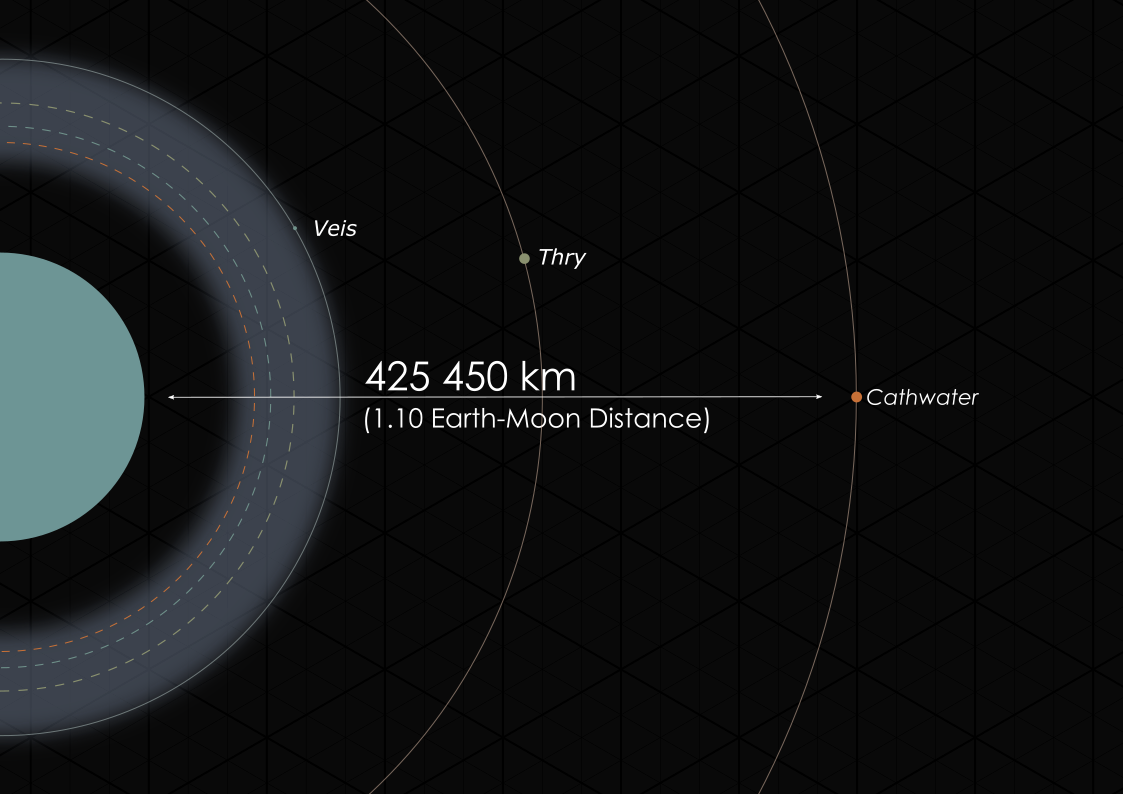
The “Star”
The body that Cathwater orbits is an… object, that I haven’t given a name yet. But I can tell you what it is — a Y0 Brown Dwarf, which isn’t really an established class of star as of the writing of this article. Not quite a star, not a planet. We might be better to call it a sub-brown dwarf.
A sub-brown dwarf is an astronomic object that is at least 3 times as massive as Jupiter but roughly ±10% the diameter of Jupiter. It’s a failed-start star, where it could never really get massive enough to sustain deuterium fusion. This means that all the heat that’s built up in it is leaked out slowly, but it still radiates a lot. Some of them get quite cool, and can radiate temperatures well below freezing (the coolest of these stars is WISE 0855-0714, with a balmy 260 K (-13 C)).
Important details we’ll need about this “star” is:
- Spectral Class: Y0
- Absolute Magnitude: 20.24
- Luminosity: 7.06×10⁻⁷ L☉ (2.72×10²⁰ W)
- Radius: 1.08 RJ (72 202.3 km)
- Mass: 11.2 MJ (2.125×1028 kg)
- Surface Temperature: 520 K (246 C)
From the surface of Cathwater, this object radiates cold. Thick bands of swirling clouds, a dim blue glow hinting underneath. This story is called Beneath the Blue Pale, so it all makes sense.
Cathwater
Stars radiate in all directions. This means that for every unit of distance, the sphere gets larger, and the solar radiation diminishes per the inverse-square law.
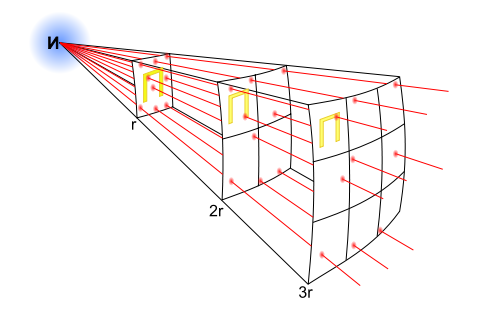
At the surface of Earth, we receive ~1000 W/m of solar radiation per year. This puts Earth into the habitability zone. You can calculate the human habitability zone for any planetary body with this formula:
- Innermost radius: √(L / 1.1)
- Outermost radius: √(L / 0.8)
Where L is the absolute luminosity of the star.
Plugging in our “star’s” luminosity, we get a lower limit of 118 094 km and an upper limit of 170 133 km. This is a problem! The rigid body Roche limit between Cathwater & the stellar object is 127 214 km. In simple terms, for it to be in the star’s habitable zone, it would be horrifically deformed by tidal stress. There wouldn’t be a Cathwater to speak of!
Cathwater doesn’t orbit in the stellar body’s habitable zone. It’s much further away, with a semi-major axis of 425 450 km. At that distance, it receives 119.41 W/m per year. This is 11% of what Earth gets. The surface temperature, from stellar body radiation alone is, is 150 K (ah, shorts weather.)
It’s a good thing, then, that Cathwater isn’t heated by stellar radiation. Remember how I said tidal stress can tear a planet apart? Up until a body is torn apart, it flexes. This flex creates friction, which in turn, generates heat. And for Cathwater, this is approximately 246 K. So, how did we get to this point?
Let’s get the important data out of the way first:
- Semi-major axis: 425 450 km
- Eccentricity: .003 68
- Orbital period: 12.86 hr
- Radius: 0.42 R⊕ (2 704 km)
- Mass: .07 M⊕ (4.083×10²³ kg)
- Surface Gravity: .38 g (3.73 ms-2)
This puts Cathwater between Mercury and Mars-sized.
Maths
That’s it. That’s the tidal heating formula (source, formula 7). And it’s a doozy. Let’s break it down.
- ρ = Density (4.93 g/cm3 = Volume/Mass)
- n = Mean orbital motion, which is √[(G×(m1+ms))/as3], where G is the gravitational constant, and m1 = stellar body mass and m2 = satellite mass, and as is the semi-major axis of the satellite. This comes out to 1.357×10⁻⁴ √kg/s.
- Rs = Satellite Radius (2 704 km)
- e = orbital eccentricity (0.003 68)
- μ refers to shear rigidity and Q for specific dissipation function. To be perfectly clear, these are observational values and I’m not on Cathwater to collect this data, so I’m using 5×10¹⁰ Pa for μ and 100 for Q.
Plugging it all in, I get it 1.91×10¹⁶ W of tidal flux. When divided by the surface area of the planet, it yields 207.69 W/m. So, add half the solar incident flux (since only one half is ever facing the solar body) to the tidal incident flux. Doing some more maths translates to 1C on the day side, and -27 C on the night side.
Conclusions
I can try to play with the numbers, but the more extreme the eccentricity, the harsher the temperature swings would go between periastron and apoastron — in a single near 13 hour day, this would average out. This also means that any orbital perturbations can completely ruin everyone’s day.